Choosing a cabin
that suits you
Your cabin is where you’ll sleep, get ready, store your things, and sometimes escape for a little quiet.
The least expensive cabin is not automatically the wrong choice. It is worth understanding what you’re choosing before you book.
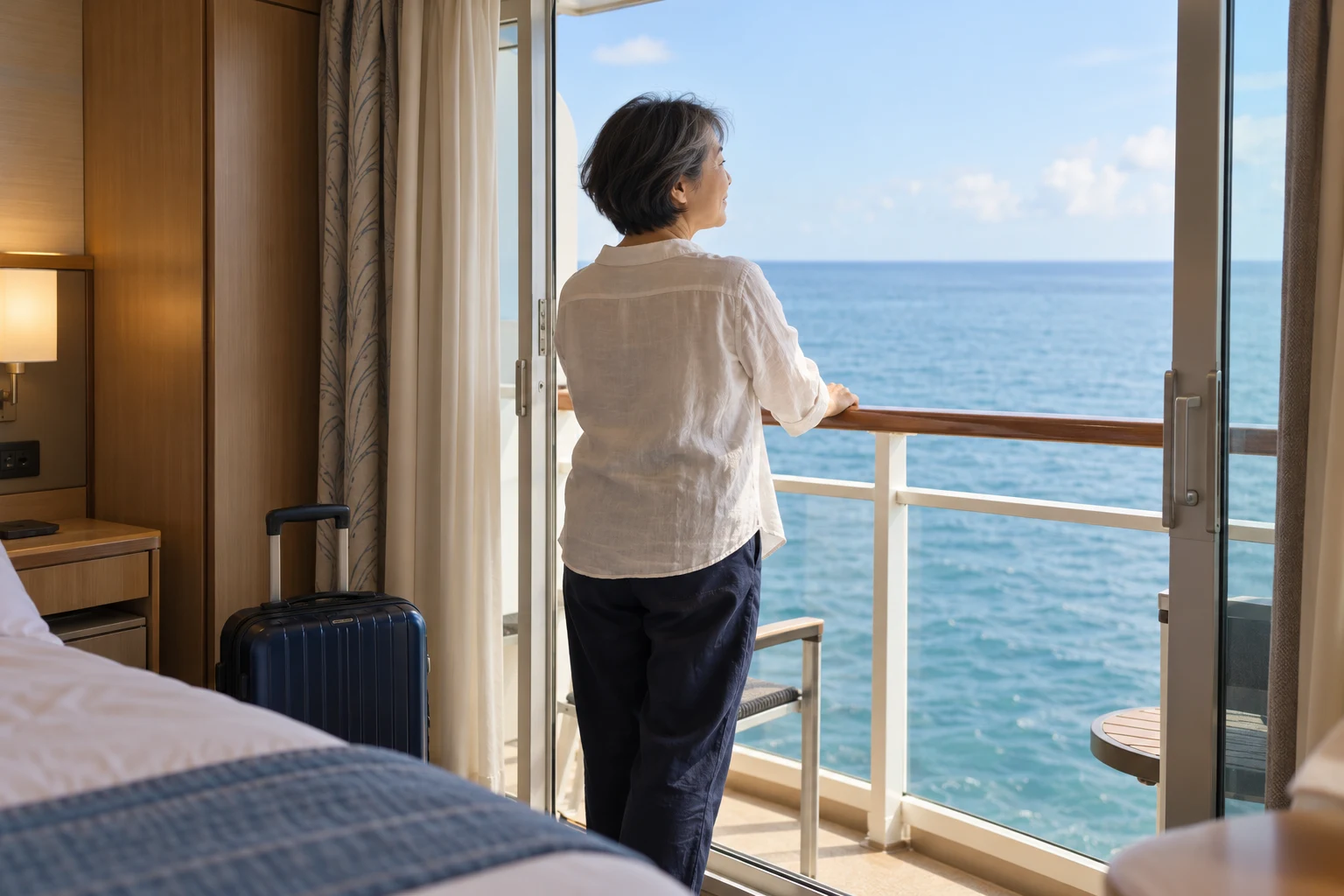
1. Start with how you travel
There is no universally best cabin. Start with how you expect to use it, rather than assuming the highest category will suit you best.
- How much time will you spend in the cabin, and does natural light matter to you?
- Would private outdoor space be part of your everyday enjoyment?
- How sensitive are you to noise or motion, and do you have mobility needs?
- Who will share the room, and what budget feels comfortable?
A port-heavy itinerary may mean you mainly return to sleep and get ready. Several sea days, an Alaska sailing, or a scenic coastal route may give you more time to enjoy your cabin and its view. Let those differences shape the choice.
2. Interior, ocean-view, balcony, or suite?
Interior cabins usually have no exterior window and are often among the lower-cost options. With the lights off, they can be very dark. They can work well if you spend most of your time elsewhere, especially on a port-heavy itinerary.
Ocean-view cabins have a window or porthole, bringing in natural light without usually providing private outdoor space. They can offer a middle ground between interior and balcony pricing.
Balcony cabins add a private outdoor area for morning coffee, fresh air, sail-away, or a quiet break. That may be especially appealing on scenic routes such as Alaska, fjords, and coastal sail-ins, or when you have several sea days. Balcony sizes and layouts vary.
Suites generally offer more space and may also include benefits such as priority boarding, private lounge access, private or dedicated dining, concierge service, or butler service, depending on the cruise line, ship, and suite category. The value can come from both the extra room and the benefits that matter to you, so check the specific category rather than assuming all suites include the same extras.
3. A balcony does not always mean an open view
Some balcony cabins are sold with obstructed or partially obstructed views. A lifeboat, ship structure, equipment, or another feature may sit within the view from your balcony.
The price difference can be small on some sailings. Read the actual cabin description and ask what the obstruction means for that particular room. If the view is the part you care about most, a lower fare may not be the better value.
Before choosing a balcony cabin, check whether the view is listed as obstructed or partially obstructed.
4. Cabin location matters
Location affects both how the ship feels and how you move around it. The tradeoffs depend on the ship and the conditions.
- Midship cabins often feel steadier than those far forward or aft and can be convenient for reaching different parts of the ship.
- Forward cabins may feel more movement and can be farther from some venues. Anchor or thruster noise may be noticeable on some ships during early port arrivals.
- Aft cabins may offer wake views, and some have larger balconies. On certain ships they can also mean more vibration or longer walks to venues toward the front.
- Lower or moderate decks may feel steadier to some motion-sensitive travelers than very high decks.
None of these locations guarantees a particular experience. Think about the specific deck plan and the places you expect to visit most.
5. Think about what is above and below you
A cabin number tells only part of the story. Review the decks above and below it for pool decks, buffets, gyms, theaters, nightclubs, and crew or service areas.
Some travelers prefer passenger cabins directly above and below them because this may reduce overhead venue noise. It is a useful consideration, not a promise of silence.
Elevators and busy corridors deserve a look, too. Being near an elevator can be helpful for mobility needs, children, or anyone who prefers shorter walks. The tradeoff may be more passing traffic and hallway noise.
Look at the deck plan above and below your cabin, not just the cabin itself.
6. If motion bothers you
Some motion-sensitive travelers prefer a cabin closer to midship on a lower or moderate deck. Far-forward, far-aft, and very high locations may feel more movement depending on conditions.
Ship size, weather, itinerary, and sea conditions all play a part. Location is worth considering, but no cabin can guarantee protection from seasickness.
7. Balcony privacy, smoking areas, and other location details
A balcony is private outdoor space, but it is not always hidden from view. Stepped deck designs and balconies overlooked from above can change how private it feels. Check the layout of the particular ship.
If smoke is a concern, look at nearby designated smoking areas. Airflow and wind direction can affect whether smoke is noticeable. A connecting door is another detail to consider if sound matters to you, since it may transmit more noise than a solid wall.
Port and starboard, the left and right sides when facing forward, are not universally better or worse. On some one-way scenic or coastal routes, one side may have more land-facing views. That depends on the route, and views can change along the way.
8. Bathroom and accessibility details
Most standard cruise cabins generally have a shower rather than a bathtub. Some suites or higher-category rooms include a tub, but bathroom size and features vary. Confirm the room specifications if a particular feature matters to you.
If you need an accessible cabin, identify that need early. These rooms may include wider doorways, roll-in showers, grab bars, or additional maneuvering space, depending on the ship and cabin.
Accessible inventory is limited and can book early. Do not assume every accessible cabin has identical features. Confirm doorway widths, bathroom arrangements, and the space needed for your own mobility equipment before choosing.
10. Traveling with five or six people?
A standard cabin may not be the most comfortable solution for five or six people, even on a ship that offers rooms with a higher sleeping capacity.
Depending on the ship and cruise line, options may include:
- A family cabin or larger suite.
- Two connecting cabins with an internal doorway.
- Two nearby cabins, including rooms across the hall from one another.
Two cabins can provide more usable floor space, two bathrooms, more storage, greater privacy, and more flexible sleeping arrangements. For some families, that works better than fitting everyone into one larger room.
Connecting combinations can be limited, and nearby cabins are not the same as connecting cabins. Plan early when a particular room combination matters. Two cabins are not always cheaper or available, so compare the actual options for your sailing.
Cruise-line occupancy rules can vary, especially when children or minors are staying in a separate, nearby, or connecting cabin. Confirm the allowed room arrangement for your specific sailing before booking.
11. Storage and everyday space
Cabin size alone does not tell you how easy a room will be to live in. Look at closets, drawers, under-bed luggage storage, vanity space, outlets, and access beside the beds. Layouts vary, even within a broad cabin category.
Think about how much luggage you bring, how many people need storage, and whether several people will be getting ready at once. A layout that gives everyone somewhere to put things may matter more than a little extra floor area.
12. Connecting cabins and family travel
Connecting cabins can give families or friends nearby space with some separation. They have an internal connecting doorway; two rooms beside one another are not automatically connected.
Request connecting rooms early if they are important to your plans, since inventory can be limited. Nearby cabins may be an alternative when connecting rooms are unavailable. Consider ages and the cruise line’s occupancy rules before choosing the arrangement.
The connecting door may allow more sound to travel between rooms than a solid wall. That can be worth weighing if quiet is a priority.
13. Guarantee cabins and assigned-later cabins
Some fares let you book a cabin category without selecting the exact cabin number. The cruise line assigns your room later. You may see this described as a guarantee or assigned-later cabin.
This can sometimes offer a lower fare, but you usually give up some control over the deck, exact location, distance to elevators, surrounding venues, view, and possible noise exposure. The category and fare terms determine what can be assigned.
It is a tradeoff between price and control, not an automatically poor choice. If location or an unobstructed view matters strongly to you, think carefully before choosing this fare type.
14. Compare the actual price gap
Cabin value changes from one sailing to another. An ocean-view may be only a little more than an interior, or a balcony only modestly more than an ocean-view. On another departure, the jump may be substantial.
Compare the real difference on your specific sailing instead of assuming one category always offers better value. Then relate that difference to the itinerary, the number of sea days, and how much time you expect to spend in the room.
Who is traveling, your desired privacy, and any mobility needs belong in that decision too. The useful question is what the difference buys for your trip, and whether you will value it.
15. One last thing
Someone who loves being outside may value a balcony. Someone who mainly returns to sleep may be perfectly happy in an interior cabin. A family of five may care more about two bathrooms and usable space than the view.
A light sleeper may care more about what is above and below the room than its category. These are different priorities, not better or worse ways to travel.
The goal is not to book the “best” cabin on the ship. It is to choose the cabin that makes sense for your trip.